Interesting stories and legends of Truskavets
Some places accumulate facts; spa towns accumulate stories. Here are the ones worth retelling on the promenade.
The shepherd and the stinking spring
The founding legend, told in a dozen versions. A shepherd (sometimes a woodcutter, occasionally a wandering monk) notices his sickly animals returning again and again to a foul-smelling puddle the healthy ones avoid — and getting better. He tries the oily water himself, his ailments recede, word spreads down the valley. Science eventually confirmed what the sheep knew: the "spoiled" water was the treasure. Locals like to point out that Naftusia thus passed the most honest clinical trial in history — the patients had no idea they were in one.
Yuzya, the water of beauty
Spring No. 11 bears a girl's name and a romantic backstory: Yuzya (little Josephine), a legendary local beauty, supposedly washed only in this glycerin-soft water — and never aged. The Victorian-era resort marketed it enthusiastically to lady guests, who took the waters of Maria and Sofia for the digestion and Yuzya for the complexion. Chemists confirm the water is unusually rich in softening organic compounds; on the eternal question of whether it stops time, the pump-room attendants only smile, which proves nothing and settles everything.
The wax that wired the world
The strangest export chapter: ozokerite from the Boryslav–Truskavets fields insulated some of the first transatlantic telegraph cables in the 19th century. The same "mountain wax" that today warms rheumatic backs once carried messages between continents under the ocean. A local physician's favourite line: "Your lower back is now connected to the history of global communications."
The guest book
The interwar resort collected celebrities the way its guests collected cups. The town's grand hotels hosted Polish ministers and marshals, opera stars and industrial barons; one villa's guest ledger, preserved in the History Museum, reads like a Warsaw society column of 1935. The tradition continues — presidents, footballers and pop stars still slip into the five-star spas, usually spotted, inevitably, in the pump-room queue, where the water enforces perfect democracy: everyone waits with the same cup.
The train that made the town
When the branch railway finally reached Truskavets in 1912, the first ceremonial train was greeted, according to local retelling, by the entire town, a brass band, and a banner reading "Welcome, guests — the water has been waiting for you for a thousand years." The line, built for a few thousand seasonal curists, went on to deliver millions. The modest station still stands — arguably the most profitable 8 kilometres of track in the history of Galicia.
The Emperor's sneeze and the lost ring
In the late 19th century, legend whispers that Emperor Franz Joseph I visited the Carpathian foothills in disguise to inspect the famous sanatoriums. He was handed a cup of fresh, ice-cold Naftusia. Unprepared for the distinct, pungent aroma of petroleum, the Emperor took a sip and let out a sneeze so grand that his gold imperial signet ring slipped from his finger and tumbled straight into the deep spring well. Though generations of treasure seekers have sifted through the mud of Adamivka, the ring remains lost. Locals claim the ring is slowly dissolving, giving Naftusia its mineral wealth—and that every sip of the water contains a micro-dose of imperial gold.
The Secret of Bronislava (The Spring of Tears)
Spring No. 3, named Bronislava, is a unique salt-sulfate-chloride spring used exclusively for gargling and rinsing the throat. Local folklore associates it with the heartbreaking tale of a young girl named Bronislava. She fell deeply in love with a young soldier who was sent to the far borders of the empire. For three years, Bronislava sat on a mossy stone in the forest park, weeping and singing sorrowful love songs, waiting for his return. Her warm tears dissolved into the soil, merging with the subterranean mineral chambers. When her betrothed finally returned safe and sound, she let out a final, joyful cry of relief. At that very spot, a highly mineralised saltwater spring burst forth. Today, it is said that gargling with Bronislava's salty water cures the most stubborn sore throats—and heals the lingering grief of separated lovers.
The inspiration of Ivan Franko’s Oak
The legendary Ukrainian poet, writer, and thinker Ivan Franko was a frequent visitor to Truskavets, finding both physical healing and deep intellectual sanctuary in its peaceful forests. His favourite spot was a colossal, ancient oak tree standing at the edge of Kurortny Park, which was already centuries old during his visits. Franko would sit beneath its sprawling green canopy for hours, writing verses and observing the tranquil resort life. According to local lore, the tree absorbed the creative energy of the great writer. Today, students, authors, and artists visit the "Franko Oak" to place their palms on its rough, mossy bark. It is widely believed that a few minutes of quiet contact with the oak relieves mental exhaustion, banishes writer's block, and grants a sudden spark of creative genius.
The artistic ghost of Villa Goplana
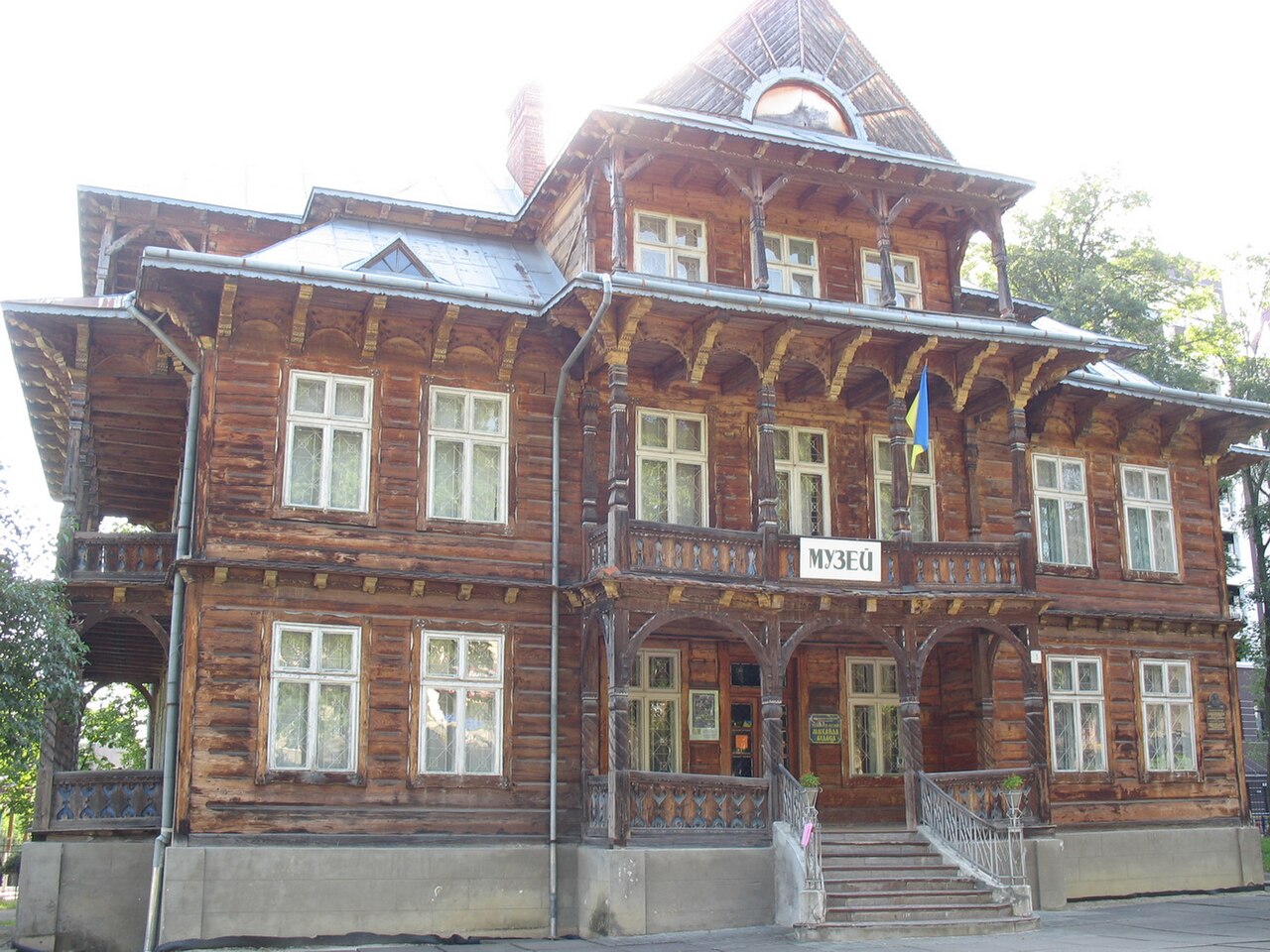
Villa Goplana, the majestic log-built residence that now houses the Mykhailo Bilas Art Museum, is whispered to have a resident night-time curator. According to museum guards and local storytellers, a friendly ghost—supposedly the spirit of a 19th-century painter who died of a broken heart after his muse married a wealthy Warsaw banker—wanders the wooden corridors after midnight. Instead of rattling chains, the spirit is known for its exquisite aesthetic sensibilities: guards have occasionally reported finding misplaced paintbrushes neatly aligned by color spectrum, or heavy woven tapestries subtly adjusted to hang in perfect geometric alignment. "Our ghost has excellent taste," a museum guide once remarked. "He doesn't haunt the building; he simply acts as our unpaid nocturnal art critic."
The Salt Giants and the White Gold
Long before Truskavets was a medical spa, it was a land of salt. Carpathian legend tells of the Salt Giants, a race of ancient mountain guardians who watched over the region’s subterranean chambers of "white gold" (salt). When human salt-miners grew greedy and began to over-excavate the hills without offering gratitude to the mountains, the Giants struck the ground with their stone clubs. They collapsed the deepest mines and redirected the pure, sweet mountain streams through the salt and sulfur beds, turning the underground rivers mineral and salty. "If you cannot harvest the salt in peace, you shall drink it instead," the Giants declared before retreating deep into the Carpathian peaks. Thus, the salt mines were lost, but the healing mineral springs of Truskavets were born.
The Baron's golden tooth
In the golden interwar era of the 1920s, a famously eccentric Austrian baron, known for his enormous wealth and equally grand temper, got into a heated argument with a local tavern owner over the price of a plate of mushroom banosh. In a fit of theatrical rage, the Baron shouted: "This dish is worth its weight in gold!" and slammed his fist on the oak table. He slammed it so hard that his finely crafted, custom-made solid gold front tooth flew right out of his mouth, ricocheted off a ceramic beer stein, and bounced out of the open window. It landed directly in the mouth of a passing wild boar that was rummaging through the tavern's compost pile. The boar bolted into the deep forest, leaving the Baron toothless and humbled. Today, local hunters and guides jokingly warn hikers to watch out for the "Golden-Toothed Boar of Truskavets"—a legendary creature that supposedly roams the Skole Beskids, flashing a blinding, imperial smile through the ferns.
The healing baton of the park conductor
The historic wooden music music bandstand in Kurortny Park, built in 1895, was the cultural core of resort life. For decades, live spa orchestras played waltzes and polkas twice a day. The most famous interwar conductor was known for his theatrical, wildly energetic style, leading guests to whisper that his flying baton was actually a therapeutic instrument. A famous Lviv composer once wrote in a letter: "The medical water works wonders on the liver, yes, but five minutes of the park orchestra's lively polka cures the melancholy of the soul."
Legends of Forest Vyshenka: Babyna and Didova Hills
The Vyshenka neighborhood, which borders the dense Carpathian forest, holds many ancient secrets. If you follow its quiet streets past the private villas and walk deep into the woods, you will find yourself in a realm of age-old legends.
The first thing a traveler encounters among the century-old oaks and fir trees is Babyna Hora (Grandmother's Hill). It is round, gentle, and covered with soft green moss, wild blueberries, and fragrant healing herbs. Right behind it, standing like a protective shield, rises Didova Hora (Grandfather's Hill) — taller, steeper, with rugged rocky ledges and mighty old trees.
According to ancient legend, a wise forest healer (the Grandfather) and his devoted herbalist wife (the Grandmother) lived on the very edge of this wild forest long ago. They dedicated their lives to curing sick villagers and guarding the harmony of the woods. When their time came to leave this earth, they begged the forest spirits never to part them and to let them remain as eternal guardians of this land. The spirits heard the lovers' pure prayer: the Grandmother was transformed into a gentle, welcoming hill that provides sweet berries and quiet comfort, while the Grandfather became a majestic, sturdy peak that shelters her with his broad shoulders from the cold northern winds.
Mysterious Forest Valleys and the Secret Spring by the Swimming Lake
If you dare to venture even further past Grandfather's Hill, the forest suddenly opens up, revealing deep, perpetually cool ravines known as the legendary Doly (The Valleys). Lore has it that in these secluded hollows, on the magical night of Ivan Kupala, forest nymphs (mavkas) and woodland spirits gather to dance in secret circles under the glow of the blooming fern, guarding the forest's quietude from mortal eyes.
But the most extraordinary secret of all awaits travelers near the forest's Swimming Lake. Hidden beneath the roots of a giant, ancient beech tree near the water's edge, a small, inconspicuous spring bubbles to the surface. Its crystal-clear water has a distinct petroleum aroma and taste, remarkably similar to the famous "Naftusia."
The old folk say that this spring was born of a forest dryad who fell deeply in love with a young Cossack wounded in battle. As the soldier lay dying by the lake, the dryad, powerless to save him with earthly remedies, wept bitter tears. Her magical tears seeped through the roots of the Carpathian trees down into the earth's deep, oil-bearing layers, bringing up a water enriched with the healing soul of the mountains. She washed his wounds and gave him a drink; the young soldier recovered instantly, gaining the strength of a giant. Since then, it is believed that anyone who bathes in the cool waters of the Swimming Lake and then takes three sips from this hidden forest spring will forever preserve youth of body, clarity of mind, and invincible health.
The Oil Valleys Outside the Town: Black Tears and Subterranean Treasures
Even further beyond the outskirts of Truskavets, where the forest grows completely wild, lie the legendary Oil Valleys (Naftovi Doly). These are deep ravines and hollows where, since ancient times, a thick, dark liquid — "earth oil," or petroleum — has naturally seeped to the surface.
An old Carpathian legend tells that these valleys were once home to the underground spirits of the mountains. For centuries, they guarded the subterranean riches from greedy conquerors. When a foreign army marched into these lands, seeking to plunder the Carpathians and enslave the locals, the spirits grew furious. They tore open the earth's crust, and from the deep abyss flowed viscous streams of "the black tears of the mountains" — petroleum, turning the valleys into impassable traps. The invaders got hopelessly stuck in the black mires, and the local people were saved.
Since then, these hollows have been known as the Oil Valleys. It is believed that the mountain spirits still brew their magic in deep cavern chambers, fusing the raw energy of the thick black oil with crystal-clear mountain streams. It is through this mysterious subterranean alchemy that the famous "Naftusia" water acquires its signature petroleum aroma and the extraordinary healing power that restores health to thousands.
The name nobody agrees on
Strawberries? An old Slavic name Trushko? Lithuanian salt-makers? The town has argued about its own name for two centuries and shows no intention of stopping — see our history series for the candidates. The consensus position, delivered with a shrug at the buvet: "The water works under any name."