History of Truskavets II — 1827 and the golden age of the spa
In part one we left Truskavets as a village of salt boilers and ozokerite miners. Part two is the story of how, within a century, it became one of the most fashionable spas of Central Europe.
1827: eight cabins by a smelly spring
The official founding year of the resort is 1827, when the landowners built the first bath-house — eight cabins where guests soaked in heated mineral water. The clientele was local gentry from Lviv and Drohobych; the "season" lasted a few summer weeks.
Science soon caught up with practice. After Teodor Torosevich's 1836 analysis of Naftusia, doctors could argue on paper what patients felt in their bodies, and the trickle of guests became a steady stream. New springs were tapped and named after the owners' families and royalty — Maria, Sofia, Bronislava, Yuzya, Edward, Ferdinand — names the pump rooms carry to this day.
The Austro-Hungarian build-out
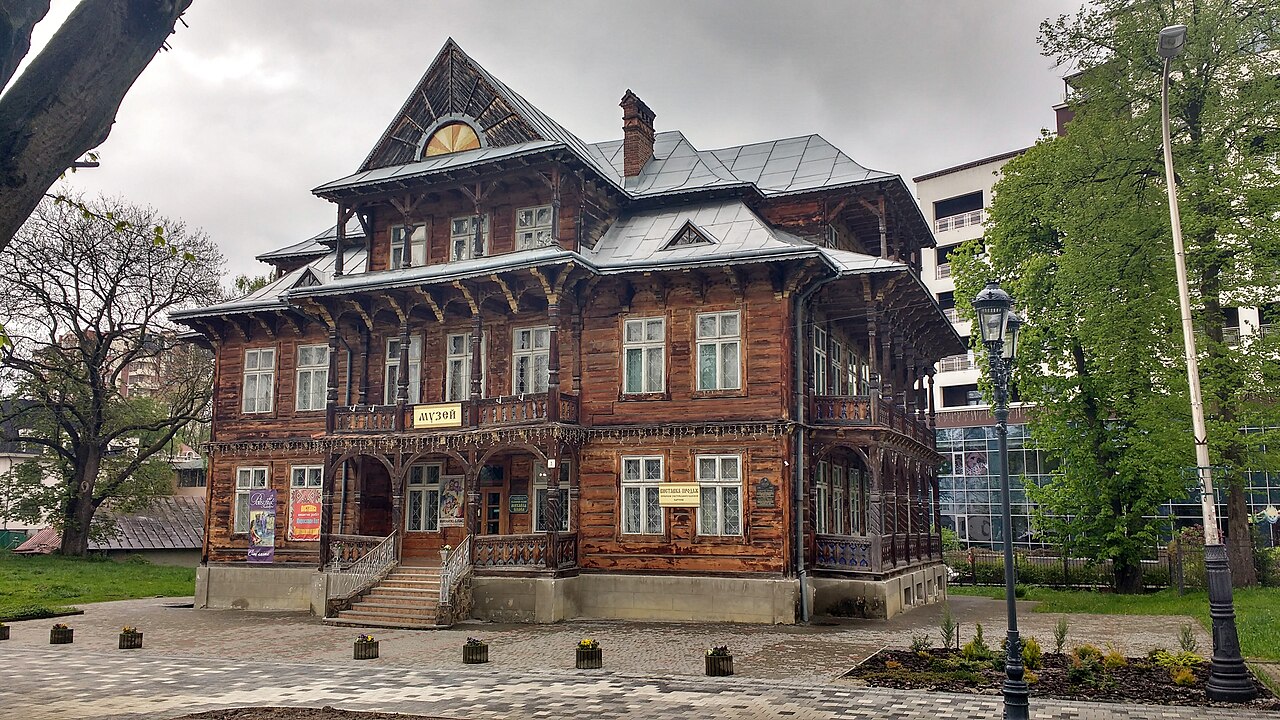
Under Austria-Hungary, Galician spas boomed as the empire's middle class discovered the Kur. Truskavets gained proper bath buildings, pensions, a spa park and — crucially — transport: the railway reached nearby Drohobych in 1872, and in 1912 a branch line brought trains directly into Truskavets. Visitor numbers passed several thousand a season. The wooden villa became the town's signature: steep roofs, carved verandas, romantic names — Gopliana, Sariusz, Under the White Eagle.
The interwar boom: Truskawiec
The resort's true golden age came under interwar Poland, when the town — then Truskawiec — became the country's premier spa. The energetic director Rajmund Jarosz modernised everything: electric lighting, a new grand pump room, sports grounds, tennis courts, concerts and dancing in the spa park. In 1933 the resort received about 17,000 guests, more than any other Polish spa; by the late 1930s estimates ran higher still. Warsaw ministers, artists and industrialists summered here; a famous guest list ranged from politicians to poets.
Two details from that era still define the town. First, the villa architecture — dozens of the wooden pensions survive, and a walk along the older streets is a walk through the 1920s. Second, the ritual of the promenade: drink your glass slowly, walk the park alleys, listen to the orchestra, repeat before dinner. The buildings changed hands many times since; the ritual never changed at all.
Clouds
The golden age ended abruptly in September 1939. War, occupation and border changes swept away the resort's owners and much of its clientele. What the Soviet era made of Truskavets — a mass health machine on an entirely different scale — is the story of part three.